Retail and consumer
Store, digital, payments, fulfilment, finance, service and operational rollout environments.

Sector experience
Battlehill Projects experience spans regulated, operational and customer-facing sectors where change and delivery control, evidence, risk management and stakeholder confidence are essential.
Understand the real delivery pressure and critical path.
Reset ownership, plan, governance and workstream rhythm.
Run RAID, suppliers, evidence, gates and decisions.
Land change through adoption, hypercare and BAU handover.
Sector map
Battlehill Projects sector content is grounded in live delivery patterns: store estates, regulated banking, insurance operations, payments, SaaS platforms, utilities, portfolio and complex change and supplier-heavy transformation.
Regulated-sector delivery
Sector credibility comes from understanding the delivery conditions: regulation, auditability, customer impact, live operations, procurement, data, suppliers and the need for clear executive confidence.
Industry-specific delivery
Battlehill Projects is relevant where sector context changes how delivery has to be controlled: regulation, live operations, customer impact, public accountability, supplier complexity and operational readiness.
Store, digital, payments, fulfilment, finance, service and operational rollout environments.
Regulated governance, auditability, customer risk, workflow, payments and service transformation.
Accountable delivery, procurement, service continuity, transparent governance and operational handover.
Supplier-heavy platforms, cloud/SaaS, cyber, service tooling, integration, acquisition, separation and portfolio control.
Enterprise delivery control
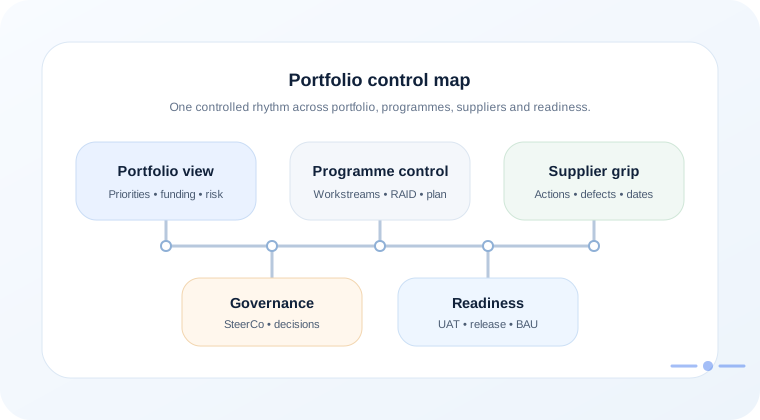
Battlehill Projects works where delivery is visible, pressured and cross-functional. The model creates a controlled path from uncertainty to execution by combining senior judgement, PMO discipline, supplier grip, release evidence and operational readiness.
Establish the true delivery position across scope, plan, governance, RAID, suppliers, finance, testing, readiness and decision quality.
Reset workstreams, ownership, dependency logic, reporting cadence, governance packs and executive escalation routes.
Control delivery through facts: milestones, risks, issues, actions, decisions, defects, acceptance criteria, supplier commitments and readiness evidence.
Move from delivery activity to operational outcome through UAT, cutover, hypercare, support readiness, adoption and BAU ownership.
Delivery evidence
Evidence is presented through the lens that senior buyers care about: sector context, delivery pressure, controls applied and the operational outcome protected.
The regulated, operational or customer-facing environment where delivery confidence had to be created.
The governance, RAID, supplier, test, release, readiness and stakeholder controls applied to the delivery challenge.
The improved confidence, readiness, adoption, transition or executive decision quality the engagement was designed to create.
Enterprise delivery profile
The delivery profile combines digital transformation, business transformation, portfolio control, ServiceNow, Microsoft Dynamics, NetSuite finance, payment implementations, PMO control, change adoption and board-visible programme governance.
Governance, audit trail, risk control and executive reporting for financial services, insurance, public sector, utilities and other high-accountability environments.
ServiceNow/ITSM, Microsoft Dynamics, NetSuite finance, payments, ERP/CRM, workflow, SaaS, Microsoft 365, data and integration-heavy delivery.
Portfolio control, portfolio sequencing, finance impacts, service transition and multi-workstream governance.
Change impacts, stakeholder readiness, training, communications, hypercare and BAU transition built into the delivery plan from the start.
Integrated sector routes
Each sector route describes a different delivery pressure pattern: stores and depots, regulated data, workflow governance, SaaS delivery, public accountability and portfolio and complex change control.
Client environments
Client environments are presented as public-facing experience indicators, with detailed references handled through appropriate commercial conversations.
















































Enterprise operating model
Battlehill Projects operates close to the delivery facts while maintaining the senior governance view required by sponsors, boards and regulated stakeholders. The model connects plans, controls, suppliers, business change and operational readiness into one delivery rhythm.
Scope, milestones, dependencies, budget impacts, workstream ownership and supplier commitments are brought into a baseline that can be governed.
RAID, action logs, decision records, test status, release gates, acceptance criteria and readiness evidence are used to drive the senior cadence.
UAT, cutover, hypercare, training, communications, support readiness and BAU handover are controlled as part of delivery, not left until the end.
Sector delivery detail
Sector delivery is shaped by the conditions of the environment: regulation, operational continuity, customer impact, suppliers, data, service readiness and stakeholder scrutiny.
Decision trails, risk control, status evidence and executive reporting that can withstand scrutiny.
Change assessed through process, people, service, data, support and customer or citizen outcomes.
Commercial and technical dependencies managed through visible commitments and escalation routes.
Testing, training, cutover, communications, support and BAU ownership planned as core workstreams.
Next step
Start with the facts: the change, the risk, the stakeholders, the suppliers, the governance gap, the adoption route and the outcome that must be protected.